The Laughing Cow Cheese | Chewsday Review
This week I'm reviewing the Laughing Cow Cheese! You can't deny the branding is cute, but let's see if the cow is laughing with us or at us.

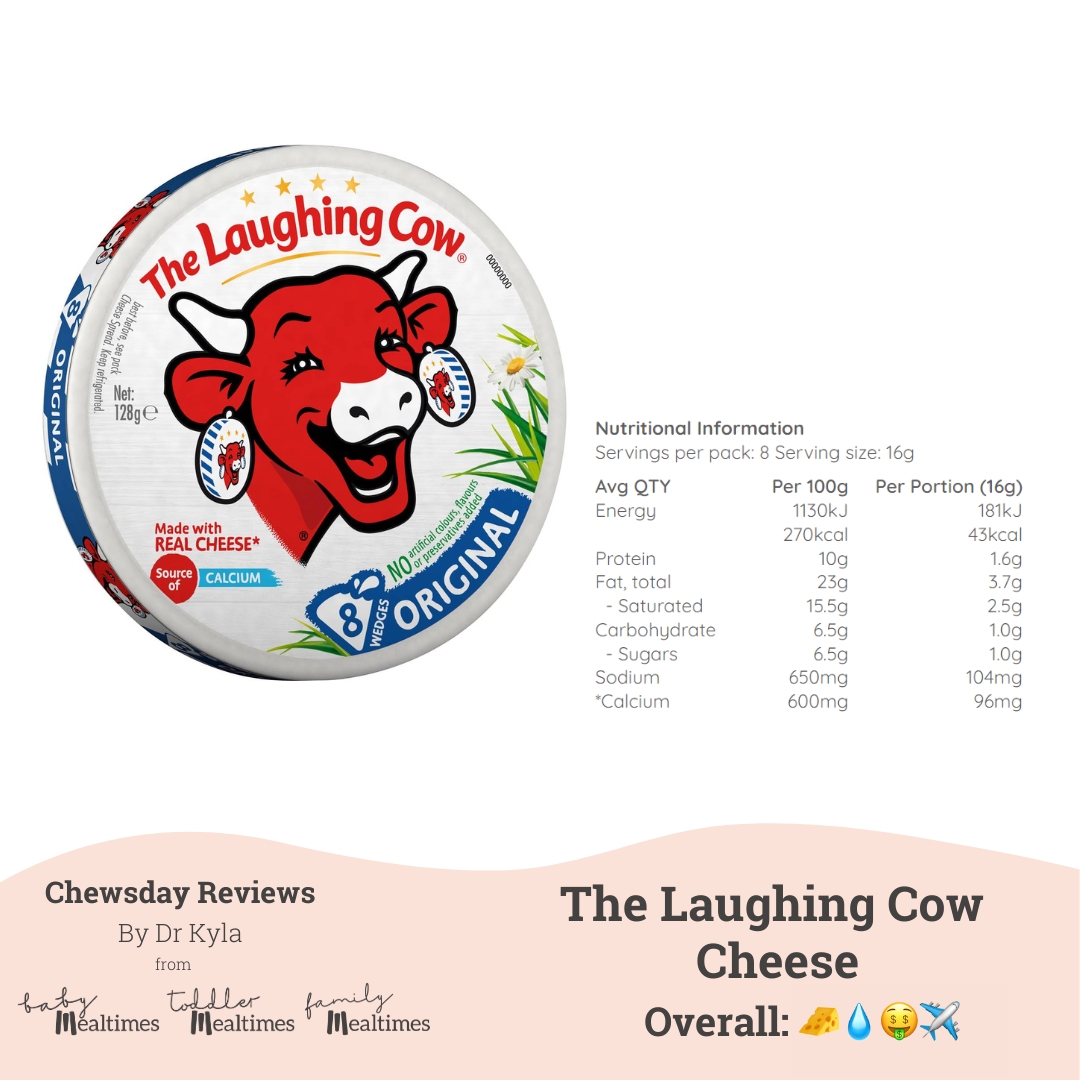
- Water, milk fat, cheeses (milk, salt, lactic acid bacteria, microbial rennet), skimmed milk powder, milk proteins, emulsifying salts (452, 341, 450, 330), salt, Vitamin D.
- Usually the first ingredient of cheese is milk, so I’m surprised to see water is the first ingredient.
- Allergens: cow’s milk.
- Laughing Cow Cheese has a reasonably high calcium content (600mg per 100g) which works out to about 3 times as much as yoghurt, but we tend to eat less in one sitting so it ends up being less total calcium. One triangle of Laughing Cow Cheese works out to be almost 20% of a toddler’s daily calcium requirements. Regular cheddar cheese tends to have a bit more calcium, at around 700-750mg calcium per 100g, but most cream cheeses are much less (<100mg per 100g).
- Like all cheese, this has a low sugar content (6.5g per 100g).
- This comes in convenient individual portions.
- The saturated fat content is above recommendations (less than 3g per 100g) at 15.5g per 100g, but is actually less than most cheddar cheeses (closer to 20g of saturated fat per 100g). It’s important to note that the evidence around dairy fats is mixed and we do not have clear evidence to recommend reduced-fat milk, yoghurt and cheese over full-fat milk, yoghurt and cheese for the general population.
- This is a fairly salty product (650mg per 100g) and while it’s about double the amount of salt in most spreadable cream cheeses, it’s still less than very salty cheeses, like halloumi and feta. Remember from our previous cheese reviews that salt has an integral role in the production of cheese, inhibiting bacterial overgrowth and balancing the acidity. The average salt content of cheese is about 620mg/100g, making it a high salt product. It’s almost impossible to change these characteristics and still make cheese.
- The 128g pack is $5, which works out to be over $39 per kg and is more expensive than most regular cheeses, like cheddar, feta and ricotta. Home brand cream cheese is closer to $12 per kg.
- This comes all the way from Slovakia, so it’s not exactly supporting local farmers and will have much higher food miles than cheese produced locally. The Coles and Woolworths versions also come from overseas, with both coming from Austria!
- “No artificial colours, flavours or preservatives added”. True, but this isn’t uncommon for cheese.
- “Made with real cheese”. This one is interesting, because it seems as though they’re saying this contains cheese rather than it being cheese itself?!
- “Source of calcium”. Yep, this is true and it’s a comparable amount to other cheeses.
- The rest of the marketing relies on the happy red cow with cheese wheels hanging from her ears. To be fair, she’s a good looking cow and that got my kids over the line.
- This is an expensive cheese product, that has cute branding, is conveniently individually packaged and contains a decent amount of calcium for a spreadable cheese. I use them in lunchboxes semi regularly.
- If you’re looking for a cheaper alternative, regular cream cheese has less sodium, but also has less calcium and no cute branding (sorry Philadelphia).
- If your family enjoy The Laughing Cow Cheese there’s no need to change. It’s a nutritious food, like other types of cheese, but if you are trying to reduce your food budget or are conscious of food miles, you might consider an alternative.
The composition of food products changes regularly. The nutritional values of the products in this Chewsday Review were correct at the time of publishing.