Aldi’s Croissant Prawn Puffs | Chewsday Review
I'm a fan of a flaky pastry, but what about these Croissant Prawn Puffs from Aldi?! Will they fill me with festive cheer or leave me feeling crabby?

- Filling (58%) (Soaked Prawn (Vannamei Prawns (Litopenaeus vannamei)) (Crustacean), Water, Salt, Raising Agent (500), Acidity Regulators (330, 331), Potato, Soaked Basa (Pangasianodon hypophthalmus) (Fish), Water, Acidity Regulators (331, 332), Onion, Spinach, Leek, Vegetable Oil, Wheat Flour, Dill, Garlic, Sugar, Salt, Coconut Powder, Yellow Mustard (Includes Acidity Regulator (260), Mustard Seeds, Natural Colour (160c), Lime Juice, Tapioca Starch, Lemon Juice, Black Pepper); Pastry (42%) (Wheat Flour, Water, Vegetable Oil, Sugar, Yeast, Garlic Powder, Salt, Raising Agents (500, 450, 341), Parsley, Tapioca Starch)).
- The packaging further clarifies that these contain 18% prawn and 5% fish.
- Allergens: wheat, gluten, shellfish, fish.
- May contain: sesame.
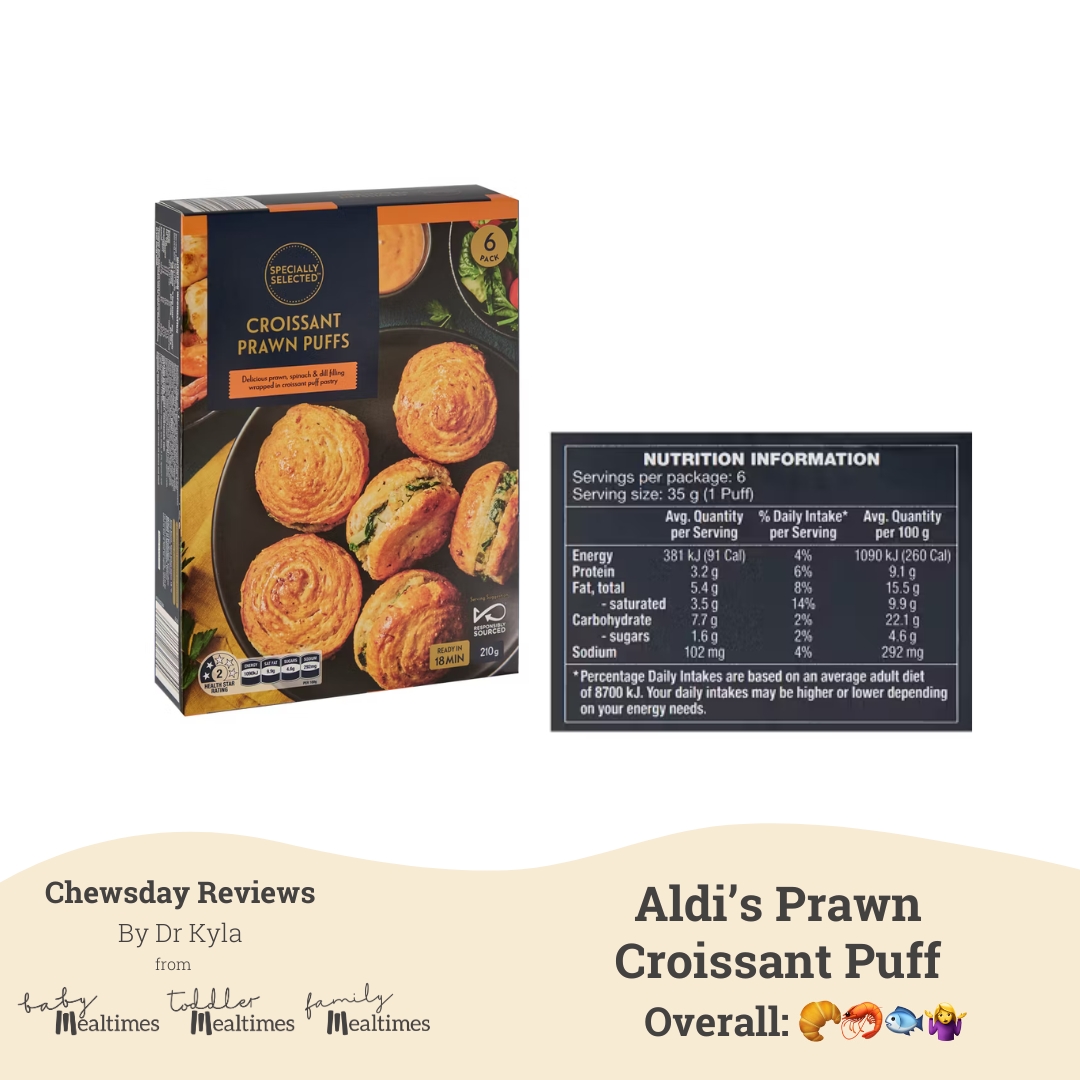
- I was surprised to see the sodium meets recommendations at 292mg per 100g. Typically frozen, savoury products can be quite high in sodium. For example KB’s Coconut Crusted Prawns and I&J Battered Prawn Pops are approximately double this amount, and even some brands of frozen cooked prawns are higher in sodium. It’s worth noting that one of these puffs is about 50% of a baby’s daily salt allowance from food.
- This does contain a little added sugar, but overall the content is low (4.6g per 100g).
- Sometimes offering seafood regularly to kids can be challenging – particularly if you don’t eat it regularly yourself. This is a convenient option that doesn’t require you to cook/prepare the prawn and fish.
- The saturated fat content is high and well over recommendations at 9.9g per 100g. This is likely from the coconut powder, although I wouldn’t be surprised if the vegetable oil used is low quality, and might even contain palm oil.
- These are only 18% prawn and 5% fish, so not a huge serve of seafood in each 35g puff. It’s hard to compare between products, but dumplings and gyoza are often at least 50% prawn so they tend to give more bang for your buck.
- I consider these quite expensive! They’re $6.99 for 6 or $33.29 per kg. And I get it, seafood is expensive… but these are only 23% seafood so I’d expect them to be a tad cheaper.
- They’re made in Vietnam, so you’re not getting any local seafood here. This is pretty standard for frozen prawn products though.
- “2 star health rating.” This means when compared to other frozen seafood products, these don’t come out on top. I suspect this is largely due to the high saturated fat.
- “No artificial colours and flavours.” Sure.
- “No preservatives.” This is a funny one, as technically the product is frozen as a method of preservation, but it contains some acidity regulators which can be used for preserving food.
- I won’t be rushing out to buy these for my family. They’re reasonably expensive for a fairly low percentage of seafood, but they could be a novel way to offer shellfish and fish to your child. If you’re offering these to your baby, I’d suggest to be mindful of the texture and what other salty foods you’re offering that day.
- If I was looking for a frozen prawn product to serve, I’d be more likely go for something like a prawn gyoza or dumpling. They can be a little higher in sodium, but tend to be much higher in seafood and often more economical.
- If you’re planning to offer these and your child (whatever age) hasn’t had shellfish or fish before (or in a very long time), be mindful that you might not want to offer on Christmas Eve or Christmas day (just in the rare instance your child has an allergic reaction).
The composition of food products changes regularly. The nutritional values of the products in this Chewsday Review were correct at the time of publishing.